


У the first article We have determined that for each group of combustible gases classified according to the Wobbe criterion in accordance with DSTU GOST EN 437:2018, individual equipment manufactured only for the combustion of a specific group of gases should be used. For each group of gases, the type of reference gas has been established, which achieves the most efficient performance of gas combustion equipment
This time, the results of calculations of the interchangeability criteria for natural gases of different deposits and alternative types of artificial and synthetic combustible gases generated as a result of production processes are considered.
Why is it important? A safe and unhindered transition from the main combustible gas to a substitute gas is possible only if certain characteristics of the combustion process are maintained, such as thermal power (N, kW); operating efficiency (unit efficiency, ƞ, %); conditions of violation of the stable operation of the gas burner in the form of: undesirable phenomenon of flame slipping into the burner body; flame detachment from the burner cut and its extinguishing; fuel combustion completeness, mg/m3 or % vol.conditions for the appearance of yellow flame flashes, which indicates the course of pyrolytic processes and the formation of sooty particles in the flame due to insufficient air for combustion.
Here is the calculation of the main physical and chemical combustible properties and criteria (indices) of interchangeability for natural gases produced in Ukraine, supplied to the gas transportation system and having the potential to get into gas burners of consumers in a certain period of time.
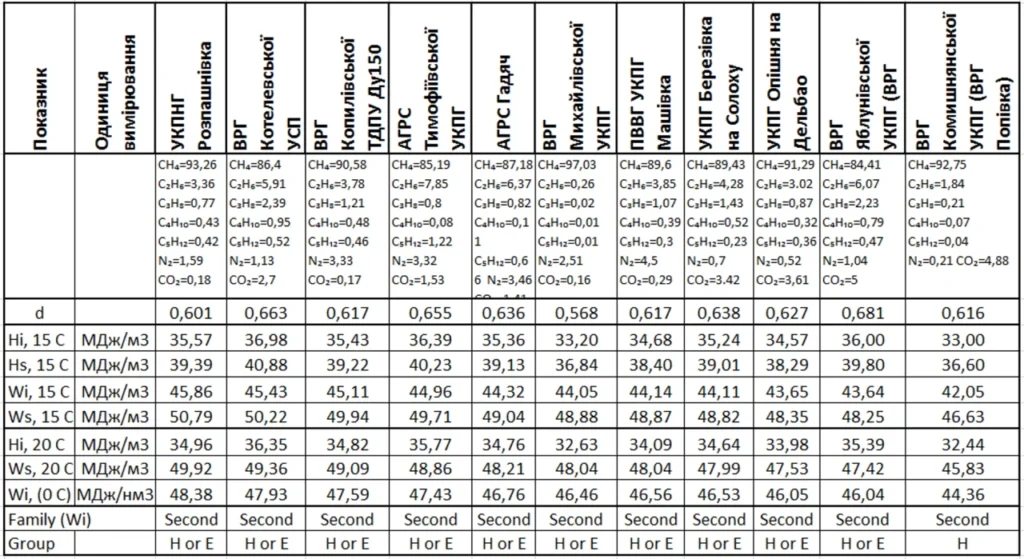
For a significant number of gases, the Wobbe index differs by more than 5%. This difference indicates that they are not interchangeable and do not correspond to the natural gas of purely L-gas fields, which until recently came from the aggressor country via Ukraine's main gas pipelines.
This leads to a decrease in gas combustion efficiency, changes in heat output, and other negative consequences.
It is also believed that most gases, according to the current classification, belong to groups H and E. Their supply for combustion to equipment made for another group (for example, L) will lead to unproductive losses in both efficiency and combustion stability.
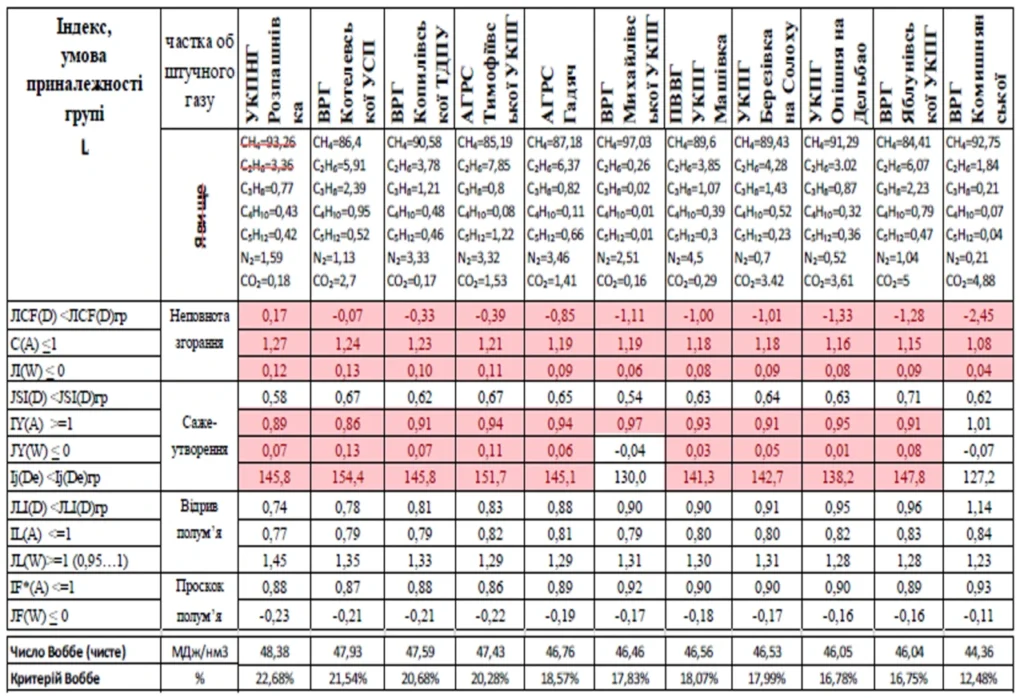
Below is the difference between the natural gases of the main gas fields of Ukraine and the reference gas of the devices in group L. In particular, the deviation of the Wobbe criterion responsible for the thermal power of fuel combustion units is 12-22%, which significantly exceeds the standard, which will have negative consequences, and the operation of the unit will be accompanied by a significant chemical underburning of combustible gas, the formation of carbon monoxide and soot. In other words, there is no interchangeability between such gases.
Table 2: Characteristics of the combustion process of gases of group H and E on existing gas equipment designed for combustion of group L gas
To ensure the efficient and sustainable use of natural gases from different fields in Ukraine, it is necessary to constantly monitor their physical and chemical properties and the values of their interchangeability indices. This can be done according to the data provided in gas quality passports. It is necessary to change the gas pressure and flow rate in front of the burner, as well as to reconfigure the operating parameters of the gas combustion equipment to ensure the required gas-to-air ratio. Domestic boiler equipment Kolvi and Eurotherm Technology are equipped with intelligent blast burners, which have the ability to easily change the pressure and flow rate of combustible gas. After reconfiguration, the burner automation system reconfigures the operating parameters and ensures the optimal ratio.
If the base combustible gas and the substitute gas that is currently supplied to the burners do not meet the conditions of variability, then it is necessary to make structural changes to the gas combustion equipment or replace it.
At the regulatory level in Ukraine, it is important to define and expand the permissible ranges of change in the interchangeability criteria that allow a particular combustible gas to enter the gas transmission and distribution system. Combustible gas suppliers are interested in this, but it must be remembered that achieving high levels of safety of use, energy efficiency and environmental safety at the stage of heat generation is the main task. The gases that do not fall within the permissible interval can be combusted in the form of mixtures with other gases to achieve the standardized interchangeability indicators.
BIOGAS, BIOMETHANE
Biogas and biomethane are another type of combustible gas that can be supplied to gas transmission and distribution networks, depending on the gas combustion equipment. The Law of Ukraine “On the Natural Gas Market” allows their supply, provided that it “complies with the regulatory legal acts on natural gas in terms of its physical and technical characteristics”.
Considering such a possibility, the main question is which regulatory documents to take into account - the outdated GOST and the “Code ....”, which do not impede the inclusion of alternative gases in the elite group, or new state regulations adapted to European standards - the current DSTU GOST EN 437:2018 and DSTU ISO 13686:2015 (for more details on the differences, see the first article).
DSTU EN 16723-1:2023 was adopted in Ukraine for biomethane. Natural gas and biomethane for use in transportation and biomethane for injection into the natural gas network. Part 1: Technical characteristics of biomethane for injection into the natural gas network (EN 16723-1:2016, IDT).
However, as for the quality parameters of biomethane, these standards only state that they must meet the requirements set out in another DSTU - EN 16726:2019 (EN 16726:2015+A1:2018.IDT), which regulates the properties of combustible gases of group H. These documents do not address the criteria for interchangeability and increased efficiency of gas combustion equipment depending on the type of gas.
The composition of biogas and biomethane, like any artificial or synthetic gas, depends on the efficiency of gas purification.
Table 3: Characteristics of biomethane
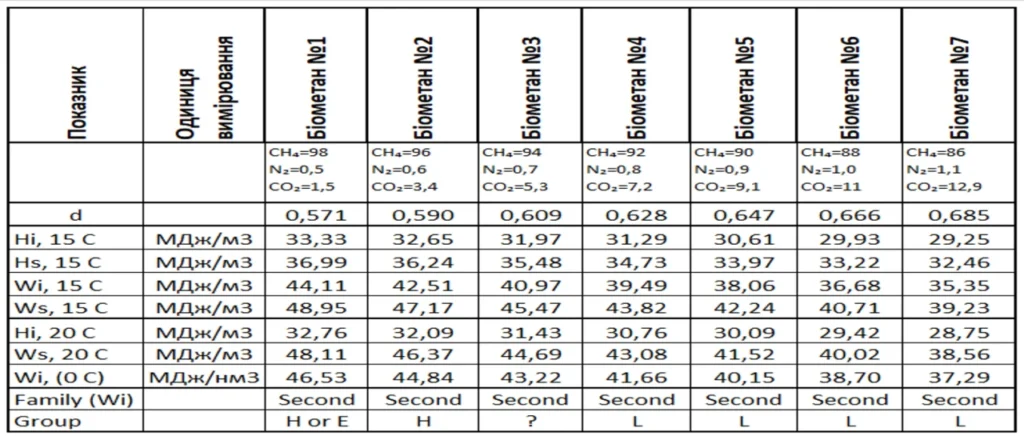
As Table 3 shows, most biomethanes belong to gas group L, a small minority to groups H and E, and one of them falls out of the general classification.
A comparison of the criteria for the interchangeability of biomethane and Group L boundary gases shows that it is doubtful that gas combustion units produced for Group L gases can be used to burn all types of biomethane.
Table 4. Results of comparison of biomethane interchangeability criteria
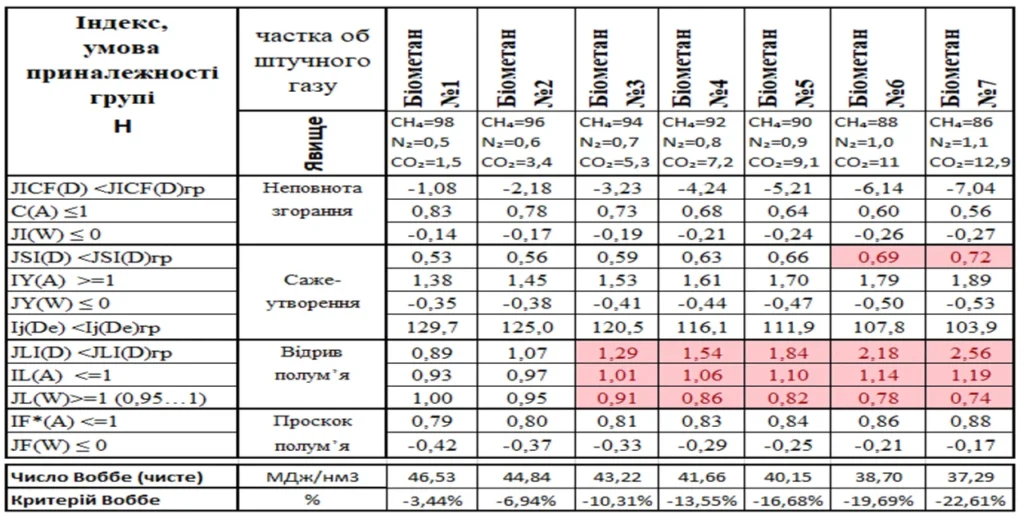
As can be seen from Table 4, biomethanes No. 3...... No. 7 will be characterized by a violation of combustion stability in the form of flame separation, and the combustion of biomethanes No. 6 and No. 7 on burners designed for group L gases will be accompanied by chemical underburning and soot formation. The interchangeability criteria accurately indicate the problems that arise when switching from basic combustible gases to substitute gases. Thus, it is not possible to state unequivocally that biomethane can be supplied to gas transportation and distribution networks.
The situation is not better with the combustion of all types of generator gases. The determination of the Wobbe index for them shows that generator gases do not even belong to the 2nd family of combustible gases of the EN 437 classification. Therefore, special burner designs are required for their combustion. They must provide for the supply of several types of gases - generator and natural.
There are also other combustible gases that are generated in the course of various technological processes (oil refining, production of carbon black and coke, and the metallurgical industry). The combustible characteristics of such gases are so low that they do not even provide the necessary conditions for spontaneous flame spread and combustion.
One possible way to burn combustible gases whose composition differs significantly from the base gas for which the gas combustion equipment is manufactured is to pretreat and combust a mixture of gases with different compositions.
Non-interchangeable combustible gases are mixed prior to their combustion in a gas burner by means of a controlled supply to a common manifold in order to obtain a gas mixture that, by its characteristics, corresponds to the parameters of the reference gas for which the gas burner is manufactured.
The corresponding control and regulation of the mixture composition is carried out by means of an electronic regulator, which, in the event of a change in the composition of combustible gases, transmits an appropriate signal to change the flow rate ratio and thus achieves the required value of the Wobbe criterion of the gas mixture (for more details on the operation of the Scheme for preparation for combustion of non-interchangeable gases, see full text of the article at the link).
Natural gas can be used as one of the combustible gases, and one of the many low-calorie alternative types of artificial and synthetic gases can be used as another combustible gas.
Equipping the scheme with automatic gas flow controllers makes it possible to efficiently combust the mixture in one gas burner without changing its operating parameters, but it leads to a higher cost of the gas combustion unit.
Thus, it should be borne in mind that producers of all types of artificial and alternative combustible gases aim to obtain permission to supply it to the gas transportation system and to obtain financial benefits. At the same time, they usually do not consider the quality of such combustible gas and the acceptability of its composition for existing gas combustion equipment and gas burners produced by industry.
The priority of regulation should not be to expand the range of combustible gases supplied to the gas transmission and distribution system, but to ensure the efficient use of combustible gas and high efficiency of gas-using equipment.
Authors:
- Anatoly Grigorievich Koliyenko, PhD in Engineering, Professor of National University “Yuri Kondratyuk Poltava Polytechnic”;
- Oleksandr Viktorovych Kroshka, D. in Architecture and Construction, CEO of Kolvi.
Source: Ekonomichna Pravda