


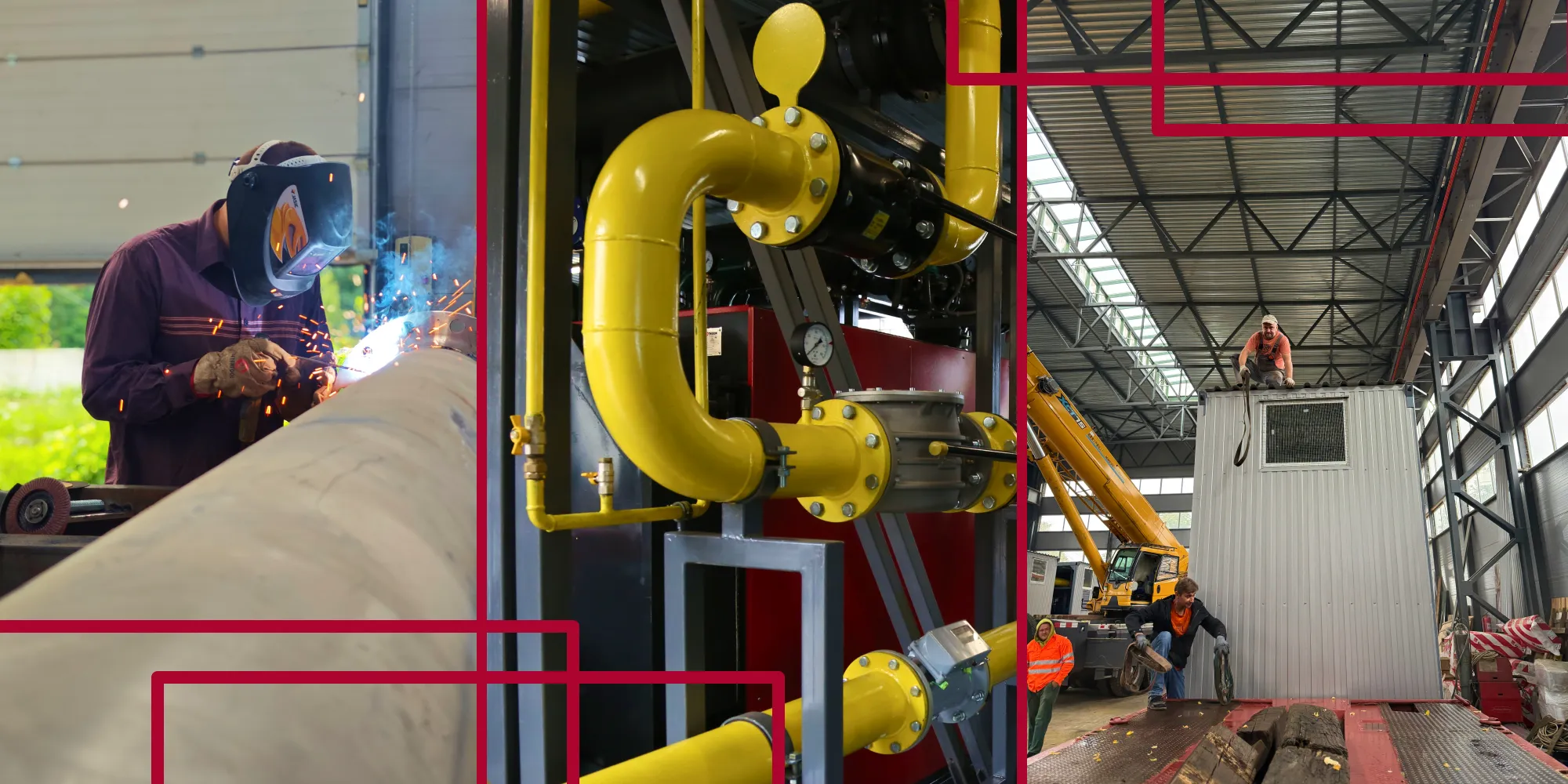
The Ukrainian company EUROTERM TECHNOLOGIES LLC is one of the leading manufacturers and suppliers of heat-generating equipment across the country. This is one of the most needed and “hottest” areas of the civilian industry in Ukraine during the war.
The company specializes in the production, supply, installation and maintenance of compact modular boiler houses that have helped to decentralize heat supply in many Ukrainian cities. In particular, large frontline cities such as Kharkiv or Mykolaiv. By the way, in the second half of 2025, the company's production facilities are focused on fulfilling an agreement with the Mykolaiv Regional State Administration, which is implementing a large-scale modernization project within the region. In general, the equipment used by the company already generates more than a third of the heat in the cities and villages of Ukraine.
“EUROTERM TECHNOLOGIES can boast that it fulfills orders very quickly. Usually, it takes no more than a quarter from signing the contract to handing over the finished and installed facility. On average, it takes about two months.
At the same time, the projects are carried out completely from scratch. “EUROTERM TECHNOLOGIES helps the customer to choose the best equipment for their needs, delivers and installs the equipment, carries out the necessary installation work, and, if necessary, also carries out maintenance of boiler houses. All this helps to quickly solve the problems of cities to restore and modernize the heat supply scheme for consumers.
In this special project, we will tell you how the company operates in the midst of war.
Ready boiler room in just a few months
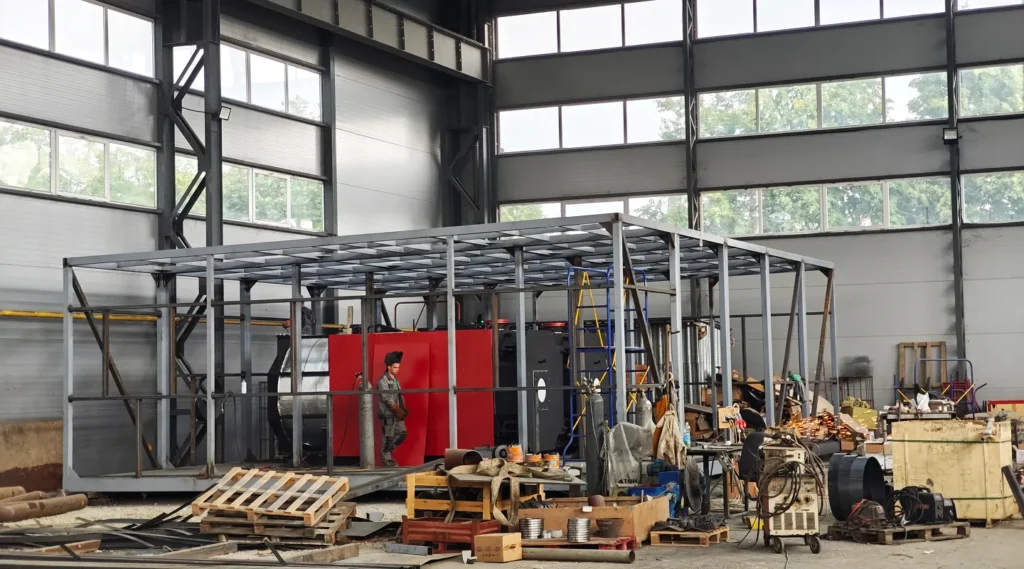
Work at the production site is in full swing. Since early morning, something has been moved, assembled, welded, and screwed together. A metal cage with two bright red boilers inside stands on a plane free of equipment and materials. It seems that they are almost ready to go to their end users, but there is still a lot of work to be done. The huge hangar houses the full boiler assembly cycle, so there are machines, components, and a crane. All metal structures for the equipment are made on site. Electronics and some parts are imported.
The company develops boiler designs in-house. The company is proud of the high efficiency of its equipment, as its own technological solutions have increased efficiency by an average of 2-10%. On a national scale, this means thousands of cubic meters of gas that will not have to be imported.
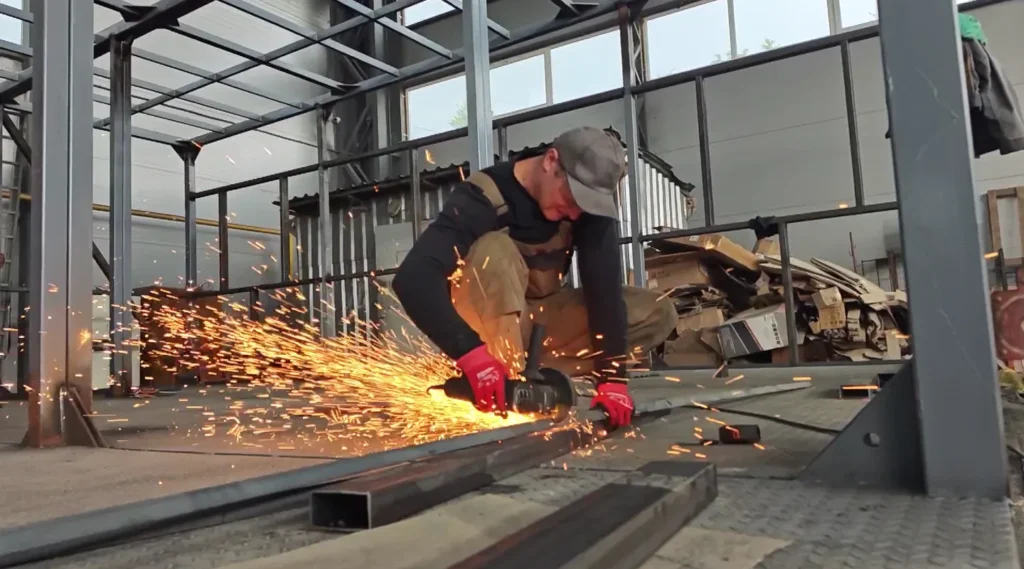
“EUROTERM TECHNOLOGIES produces boilers that run not only on gas and alternative fuels (solid fuel boilers). These are small units for household consumers and industrial boiler houses that can heat large buildings, residential complexes or even entire neighborhoods. The company receives most orders for the manufacture of block-modular boiler houses that can provide heat to an entire neighborhood and can be moved to other facilities if necessary. We can see the production process of such a boiler at the plant.
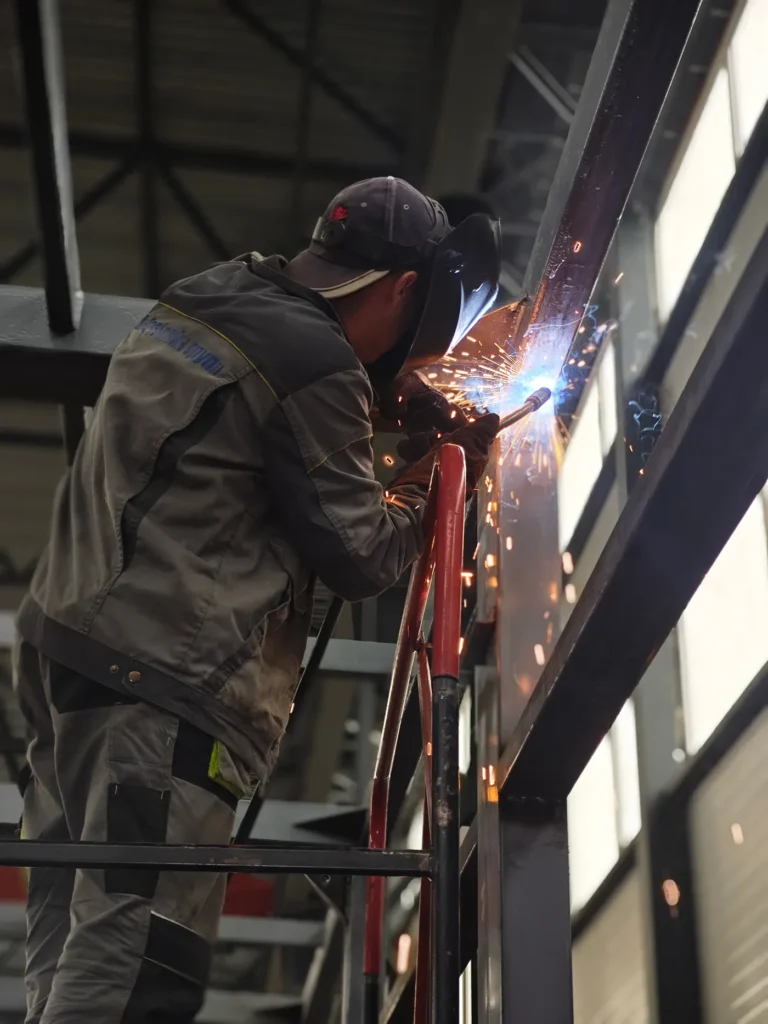
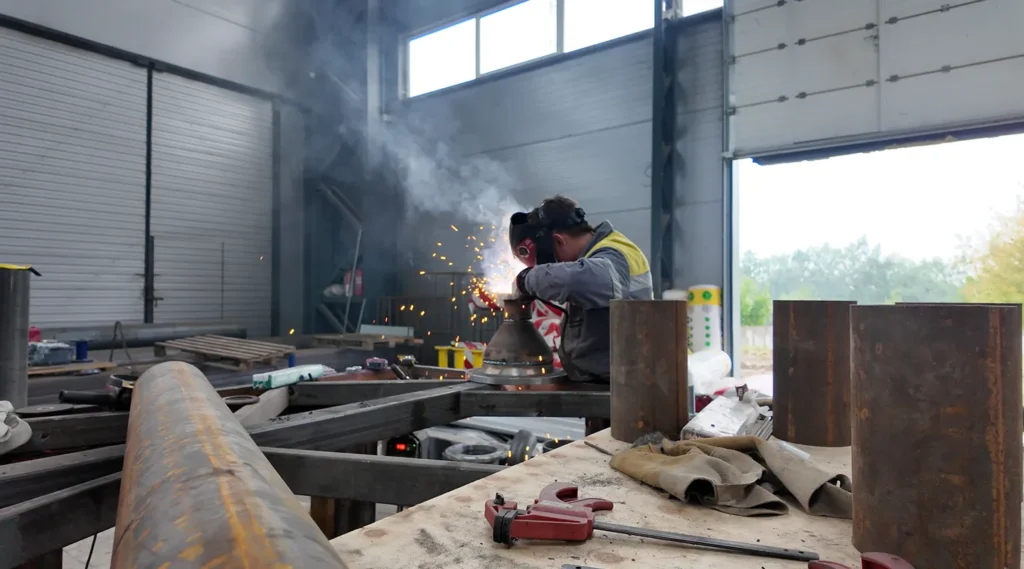
“We are welding a structure for an 8 MW block boiler house. The frame is almost ready. Two boilers of 4 MW each have been installed. We will finish the frame and then sheathe it. The entire process of manufacturing such a boiler house takes 2 months.”, Yevhen Bondar, a welder, says.
According to Oleg Vaisburd, CEO of EUROTERM TECHNOLOGIES LLC, it can take from 1 to 3 months to manufacture one boiler. The exact time depends on the supply of components, as they are not stored in warehouses due to safety factors. Most suppliers work in such a way as to ship equipment to customers immediately, without storing it anywhere.
“No one keeps components in warehouses because it is very dangerous for suppliers. So we work as follows: we received the funds, distributed advances and are waiting for everything to be assembled.
Recently, one of our main suppliers brought in equipment and was supposed to ship it promptly, but during another massive shelling the warehouse was damaged and the equipment was damaged. Therefore, there are no guarantees that you will buy the equipment and it will be delivered within the time frame agreed upon,” says Oleg Vaisburd.
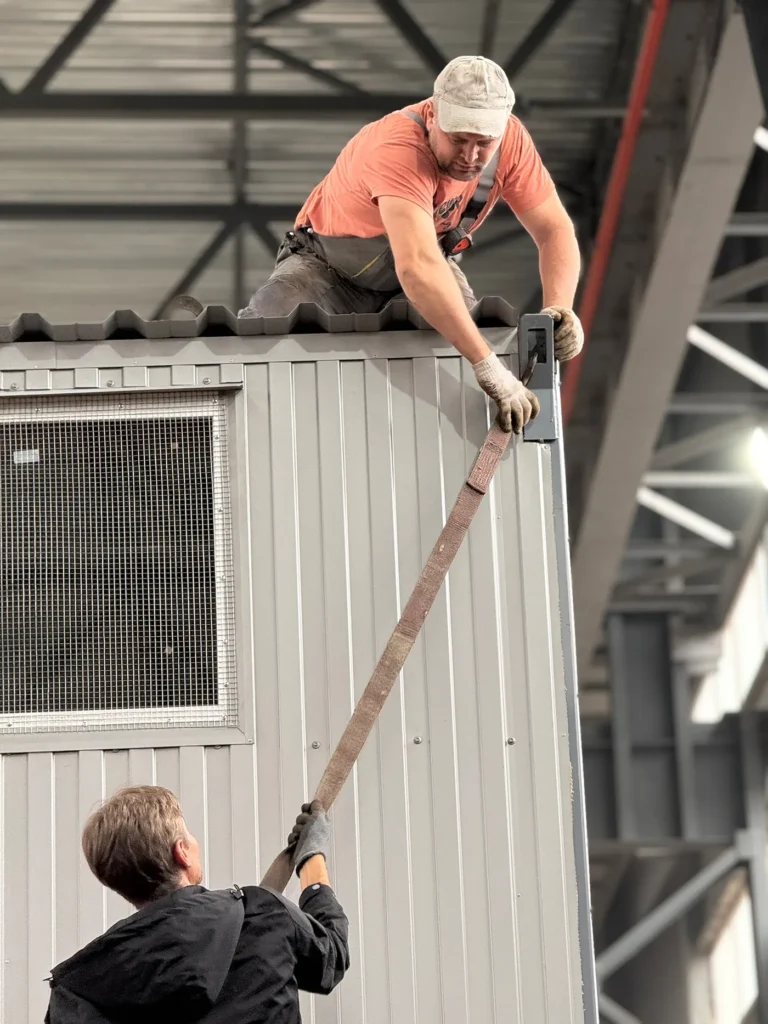
But ready-made boiler houses can be assembled on site very quickly, literally within a week. Before delivery, the parts of the finished module are separated and packed for shipment. The container with all its contents is loaded onto a huge truck and sent to the customer. An 8-megawatt boiler house is five containers, the production team explains.
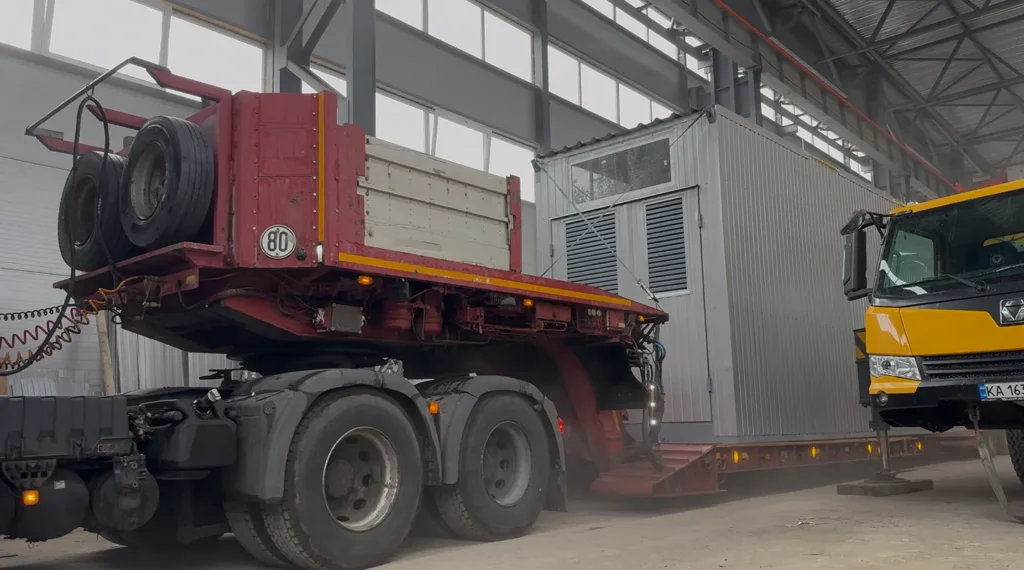
“The container is not very heavy, but it is large in terms of size, so not every machine can take it. We use a sliding trawl that can be adjusted to the size of the cargo.”, – says Petro, a representative of the logistics company.
On site, the module parts are assembled together, and the boiler room is connected to the building's heating network. Depending on the needs, they choose equipment that can run on natural gas or other fuels such as firewood, pellets, or coal. In this way, it is possible not only to quickly solve the problem of heating several thousand residents, but also not to depend on a specific type of fuel in a situation where the enemy is focused on destroying the gas production and supply system.
Heat for frontline Mykolaiv
In February 2025, Russia attacked the Mykolaiv CHP plant with shaheds, leaving 100,000 Mykolaiv residents without heat during the coldest month of winter. In total, almost half of the city lost heating, as this thermal power plant accounted for about 40% of Mykolaiv's subscribers. The local authorities quickly drew the appropriate conclusions and spent the summer months looking for solutions to ensure that the city's residents would not be left without heat in the event of more shelling.
Thus, in July 2025, the Department of Urban Development, Architecture, Capital Construction and Development Project Support of Mykolaiv Regional State Administration signed five agreements for the purchase of block-modular boilers worth UAH 1.08 billion. Under these agreements, EUROTERM TECHNOLOGIES LLC will supply five boilers. The rest of the equipment will be supplied by 4 other domestic companies.
“There was a request to build 18 boiler houses. The work had to be completed by the end of November, when the heating season begins. A tender was held, and the facilities were distributed among manufacturers according to the best price offers. We got 5 boiler houses. So, we signed agreements for them.”, Oleg Vaisburd recalls.
To be in time for the heating season, the company had to launch production quickly. However, the company did not have enough funds to start the process.
“The nuance of the agreements was that they provide for payment upon completion of the order. That is, it means building «without money». To start the production process on time, we used bank financing - we received a quick loan for a short period.
In theory, part of the money from the customer could be received in advance. But this is a very complicated system. It's not clear when the money will arrive. The advance payment can come in a month or three. So you can't count on it when there are deadlines. And five boiler houses is a pretty significant amount. Fortunately, we have a good history of relations with the banking system.
After the loan was approved, we invited the investors who provided us with the funds to show them the production facilities and how we use the financing provided to us. And as soon as we started shipping the finished boilers, we immediately began to reduce our loans,” says Oleg Vaisburd.
The capacity of the boiler houses that the company has committed to supply ranges from 1 to 8 MW, for a total of about 16 MW. In total, the city will receive 70 MW of additional heating capacity, in addition to other measures taken by the Mykolaiv authorities. So this winter, the city will be much less dependent on central heating facilities, which are likely to be attacked by the Russians again.
A year earlier, similar solutions proved effective for Kharkiv. After failing to capture the regional center, the Russians set about turning the lives of the city's residents into a nightmare. In the first two years of the full-scale war, the old heating system in Kharkiv was severely damaged and in some places completely unusable. So Kharkiv residents decided on a kind of experiment, replacing old heat generation facilities with new small modular boiler houses. It seems to have worked quite well - at least last winter, Kharkiv residents had access to the benefits of civilization.
Not only heat supply security, but also resource savings
The dispersal of heat supply facilities to protect urban residents is a problem that comes to the fore during war. However, in peacetime, small boiler houses close to the consumer will also demonstrate significant advantages alongside huge centralized heating plants. First of all, it is about saving resources, which can be achieved by minimizing losses in the networks. And secondly, it is again a safety factor. The outdated equipment of Ukrainian thermal power plants and CHP plants built in the middle of the last century can fail even without Russian shelling.
“When boiler houses are located in districts, it is, first of all, more efficient because they are closer to their consumers. Heat loss in heating networks, which can reach tens of kilometers, is minimized. And secondly, if there are twenty boiler houses instead of just one, any city can provide its services more safely. Even in peacetime, one large boiler house can break down at any time for some reason, and the whole city will be left without heat. Well, the bitter truth that we have seen over the years is that if there is one large CHP plant, it is a facility that is constantly under threat of being hit.” says Oleg Vaisburd.
Therefore, the need for decentralization and the modernization of heat supply in Ukraine in general was discussed long before 2022. Why is this finally being done during the war? Obviously, because after enemy shelling and the targeted destruction of old infrastructure, city authorities are simply left with no choice. They have to invent a bicycle on the fly that will get them through the next winter. Although we can pay tribute to the mayors of cities - a lot has already been done throughout Ukraine. But the main thing is that the modernization of heat supply does not stop at the end of the war. Outdated huge heat generation facilities need to be retired, and Ukrainians need quality services.
“From my point of view, the decentralization process is quite active. But resources are limited, and there are still many cities where decentralization needs to be worked on,” Oleg Vaisburg believes.
The expert also draws attention to the status of enterprises that manufacture equipment for the country's heat supply. Despite the importance of this work for the country, EUROTERM-TECHNOLOGY LLC failed to obtain the status of a critical enterprise. Consequently, the company is not currently able to book specialists.
“We are not critical infrastructure, but we manufacture equipment that goes to critical infrastructure... As a result, it is difficult to find specialists. And not only here. After all, we mostly employ men. There are a lot of requests from customers, and we can't cover them all. Therefore, we are working on the projects we have already committed to, and we will be busy by the end of the year.”, Oleg Vaisburg emphasizes.
Source: Economic Truth