




Modern heat supply systems produced in Ukraine can significantly increase the resilience of the country's energy system to hostile attacks.
During the spring and summer, the Ukrainian energy sector came under the aggressor's attack: massive attacks damaged thermal and hydroelectric generation facilities and electricity transmission systems across the country. Attacks on various types of energy facilities with drones, ballistic missiles, or artillery are recorded almost daily. The damage caused by Russia has long since exceeded 1 billion dollars.
The rear regions are also suffering greatly, but the frontline areas are particularly affected. For example, in Kharkiv and Kherson oblasts, the number of consumers who remain without power due to the fighting is in the tens of thousands. In the winter, when the lack of electricity is compounded by the lack of heat, some regions may be on the verge of a humanitarian catastrophe.
Despite the enemy's obvious goal of preventing the country from preparing for the next heating season, local authorities, in partnership with businesses, continue to implement successful projects to strengthen the heat and power sector. The experience gained during the winter of 2022/2023, when the energy sector was also subjected to hostile attacks, is useful. As a result of those events, the concept of decentralization of the energy sector emerged, when instead of building and reconstructing giant thermal power plants, the focus should be shifted to installing small generation facilities close to the consumer. In the heat supply sector, small modular boiler houses running on different types of fuel and capable of heating entire neighborhoods even in the event of a local power outage are becoming popular. How this is implemented in practice and what solutions in this area can be offered by the Ukrainian manufacturer, we tell in a special project of Ekonomichna Pravda and KOLVI-HUB.
The old large generation is inefficient and vulnerable
Until 2022, Kharkiv was Ukraine's second largest city, an industrial giant, and a major scientific and cultural center. Today, Kharkiv is one of the cities in the country most affected by Russian aggression. As of the beginning of this year, the damage to the city has already amounted to 10 billion dollars, the local authorities estimated.

The Russians are seeking not only to destroy the city, but also to make life unbearable for its residents by depriving them of access to basic civilized benefits. Kharkiv's civilian infrastructure is under constant shelling: during the full-scale war, missiles and drones have damaged about 200 heating facilities in the city.
“CHPP-3 and CHPP-4 were repeatedly damaged. About 50 boiler houses, the same number of central heating stations, ten individual heating stations and three pumping stations were damaged. More than 20 kilometers of heating networks, administrative buildings and other facilities were destroyed. According to our estimates, the enterprises have suffered losses of UAH 2.5 billion,” commented Ivan Kuznetsov, Director of the Department for City Life Support of Kharkiv City Council.
Before the war, the population of Kharkiv reached almost 1.5 million people. The city was known for its large residential areas, where about 70 thousand residential buildings of various types were built. All of them were heated mainly by several huge thermal power plants, which were simply inefficient and now vulnerable to attacks.
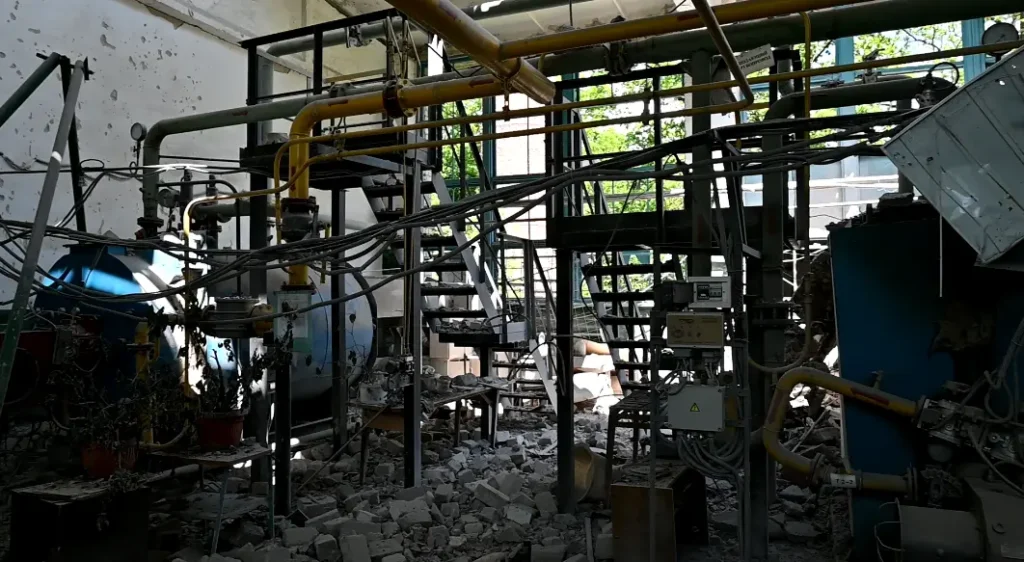
A similar picture can be observed in all major cities in Ukraine that were built during the Soviet era. We inherited a centralized design of the energy system with all its problems and vulnerability to Russian air raids. Even during the last “campaign” to destroy the national energy system, Ukrainians experienced the shortcomings of large energy facilities that are easy to target and whose coordinates are well known to the enemy. Repairing energy giants requires significant funds and almost years of time.
Kharkiv residents chose modular boiler houses to replace large-scale generation
As centralization of the energy and heat supply systems is a significant problem for Ukraine, Kharkiv residents have found a way out in decentralization. Local authorities, municipal heat suppliers, businesses, and international donors are working on a new heat supply scheme for the city, helping to finance modern heat and power projects. By the end of the year, the city plans to install more than three dozen modular boiler houses. Half of this number had already been installed by last winter.
“We have been following the path of decentralization of heating since 2021. And during the war, the city's energy system, built in Soviet times on the basis of large generation sources, showed that it was not only inefficient but also vulnerable,” said Ivan Kuznetsov.
According to the official, the Kharkiv city government has agreements with the International Bank for Reconstruction and Development, USAID, and European cities that provide Kharkiv with various equipment.
According to Kharkiv Heating Networks, the priority used to be to improve the efficiency of heat supply, but now it is clear that small facilities scattered throughout the city are a vital necessity.
“Since the beginning of the war, we have taken the installation of modular boiler houses as a basis. We want to eliminate or at least minimize the options when a large number of people are left without heating for a long period of time when they hit a large source. If there is one large boiler house and 100 houses are connected to it, then all these houses will be left without heating upon arrival. If there are 3-4 modular boiler houses with 30 houses connected to each of them, the probability that all these boiler houses will fail at the same time is almost zero. We chose quite clear and easy-to-use boilers from a domestic manufacturer, KOLVI. We constantly interact with them both during the commissioning process and to resolve issues that arise during the heating season,” says Yevhen Kaurkin, Technical Director of Kharkiv District Heating Networks.
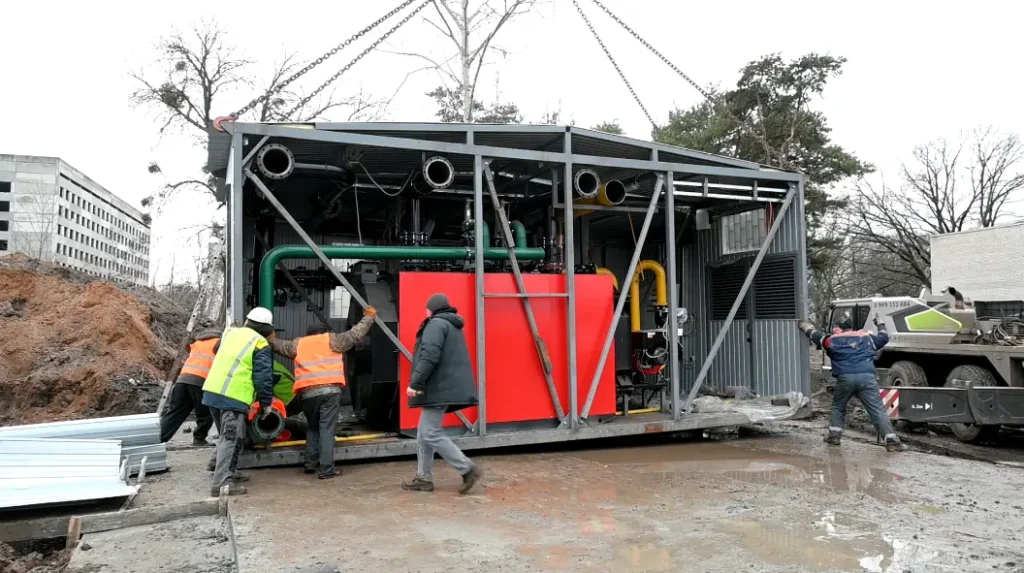
Modular boiler houses have a number of advantages that are not available to traditional heat and power facilities. They are delivered to the site ready-made, and their installation and commissioning takes from several weeks to several months. The boiler house elements are assembled like a construction set using a modular block system. If necessary, the facility can be moved to another location. A nice bonus is significant gas savings. Since modern technologies are used in the production of such modular boiler houses, they can boast of high efficiency.

“This is a 90 percent % ready-made product that saves time in preparing for the heating season. To make them work, we need to obtain permits to connect utilities, pour the foundation, install chimneys, the boiler house itself and connect heating networks to it, which takes several months,” says Serhiy Melnychenko, Head of the Operations Department at Kharkiv Heating Networks.
A small cogeneration unit is being installed at the site along with the boiler house to ensure that the boiler can operate even in the absence of centralized power supply. In normal operation, the unit allows the boiler house to operate and also supplies excess electricity to the grid.
“This is one of the examples of the implementation of the decentralization strategy in the city - the production of both electricity and heat. The cogeneration unit provides electricity to the boiler house, and the boiler house, in turn, heats about 40 residential buildings. This is heat for 7-8 thousand people,” adds the technical director of Kharkiv Heating Networks.
Will the experience of one city be useful for the whole country?
Small modular boiler houses running on alternative fuels received their first wave of popularity long before the full-scale invasion. Back then, the expediency of installing them was justified by the cost-saving factor: instead of burning expensive gas, it was much more profitable to heat with wood chips or pellets. This allowed us to kill several birds with one stone: efficiently utilize agricultural waste, save on the delivery of fuel usually purchased from local producers, and avoid non-renewable fuels.
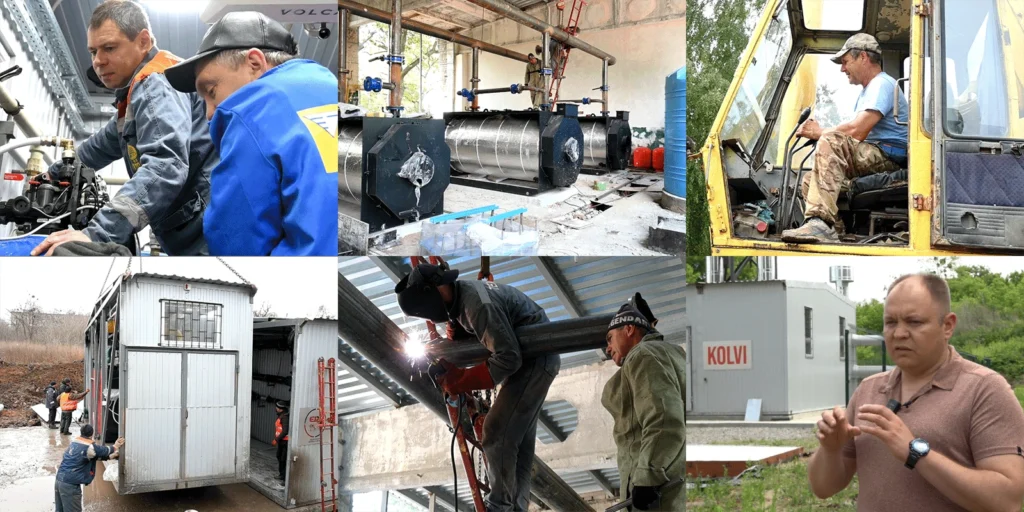
Ukrainians are well aware of the example of the city of Slavutych, where Ukraine's first 10.5 MW block-modular boiler house running on alternative fuels was built.
In the midst of the war, the experience of Zhytomyr was also positively evaluated, where, thanks to modular boiler houses, local authorities were able to provide minimal comfort to residents during hours-long power outages.
Therefore, there are already efforts to decentralize the energy system. And Ukrainian business is ready to cooperate with local governments to establish the process of supplying the necessary equipment and technical support.
“Our company is involved in the process of decentralization of heating systems at the level of technological and consulting solutions. These solutions are a reliable answer to the outdated Soviet standards of heating networks organization, as their decentralization significantly complicates the enemy's intention to leave hundreds of thousands of our citizens without heating. Right now, we are actively working, and, according to experts, the upcoming heating season is a sure thing,” emphasizes Oleksandr Kroshka, head of KOLVI.
Modern modular boiler houses are powerful enough to provide heat to entire small neighborhoods. Smaller facilities can be installed as an autonomous heating source for schools, hospitals and other socially important buildings. Thus, new heating facilities are not a temporary solution for the duration of the war, but a sustainable solution that will work after the victory.

What hinders the large-scale restructuring of the energy system is the lack of funding and qualified workers.
“A large number of specialists are going to war to defend the country. So we will engage women,” says the director of the Department for City Life Support of the Kharkiv City Council.
In terms of funds, the government is trying to partially solve this problem as part of the Strategy for Decentralization of the Energy System of Ukraine. Currently, Ukrainians are offered preferential loans for energy equipment, simplified connection of new installations, and grants for the installation of solar generation and heat pumps. The state will also support communities that initiate the installation of modular boiler houses on their territory.
Source: Ekonomichna Pravda